
*New* K-6 Report Card Proficiency Scale
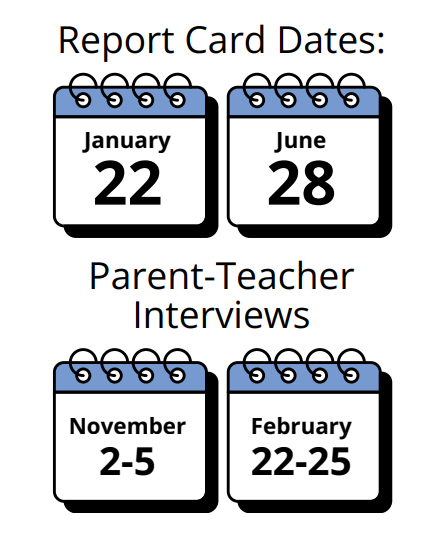 This school year, families of students in Kindergarten to Grade 6 will notice some changes to how we share information about student learning. Below is what's changing and why, including two report card dates and two parent-teacher interview weeks to mark on your calendar.
The Divisional Elementary Report Card shares your child's progress and achievement based on Alberta curriculum learner outcomes. It also celebrates student success and encourages growth throughout the school year. It is built on three guiding principles:
|
What's changing
In past years, elementary report cards went home three times a year. This year, there will be two formal reporting periods, on January 22 and June 28.
Along with the change in reporting periods, there will be an adjustment in when Parent-Teacher Interviews will be held this year. For the current school year, in-person interviews will take place during the weeks of November 2 to 5 and February 22 to 25. Your child's school will share details about booking a time.
Perhaps most importantly, elementary report cards will now use a new proficiency scale defined by levels of achievement, not numeric scores or grades, to describe how well a student understands specific learner outcomes as identified within the Alberta curriculum. This refined system of reporting uses a five-point scale with more strength-based language. Under our previous four-point system, where students received a 1-4 to represent their academic abilities, a 3 covered a wide range of achievement. This sometimes left families surprised when results in junior high looked different from what they had seen in elementary. The new scale is designed to give a clearer picture to both parents and students earlier in their academic journey.
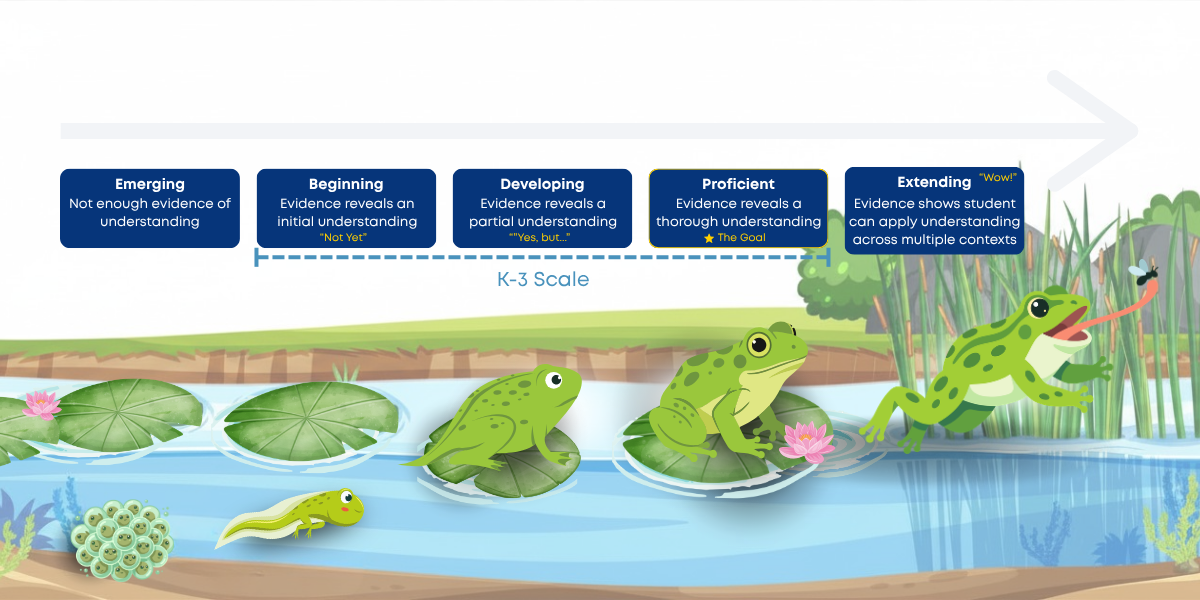
In Kindergarten to Grade 3, parents will see just the three middle parts of the scale represented on their child’s report card. For families with students in Kindergarten, this is an additional change from previous years. Kindergarten students previously had their own competency scale, and this year they will use the same scale as students in Grades 1 to 3. The three levels are:
Scale | Description |
|---|---|
| Beginning (BE) |
|
Developing (DE) |
|
Proficient (PR) |
|
As noted in the chart above, Proficient (shown as PR on a report card) is the goal for all students.
For our students in Grades 4 to 6, there are two additional levels that will be used. Together, the five levels run from Emerging (EM) at the beginning of the scale to Extending (EX) at the top.
Scale | Description |
|---|---|
Emerging (EM) |
|
Extending(EX) |
|
By including these additional levels in Grades 4-6, our report cards will more accurately reflect a student’s academic abilities ahead of their transition to the traditional grade letter system used in Grades 7-12.
Questions?
If you have questions about your child's report card or the new scales, please contact your child's Principal.
.webp)